Frankie LaPenna's cage fight with Chinese 'Terminator' robot sparks regulatory backlash
Viral man-vs-machine bout puts San Francisco startup REK under pressure as robot combat booms, from China's arenas and falling rental prices to new rules, lawsuits and workforce AI debates in Europe and the US.
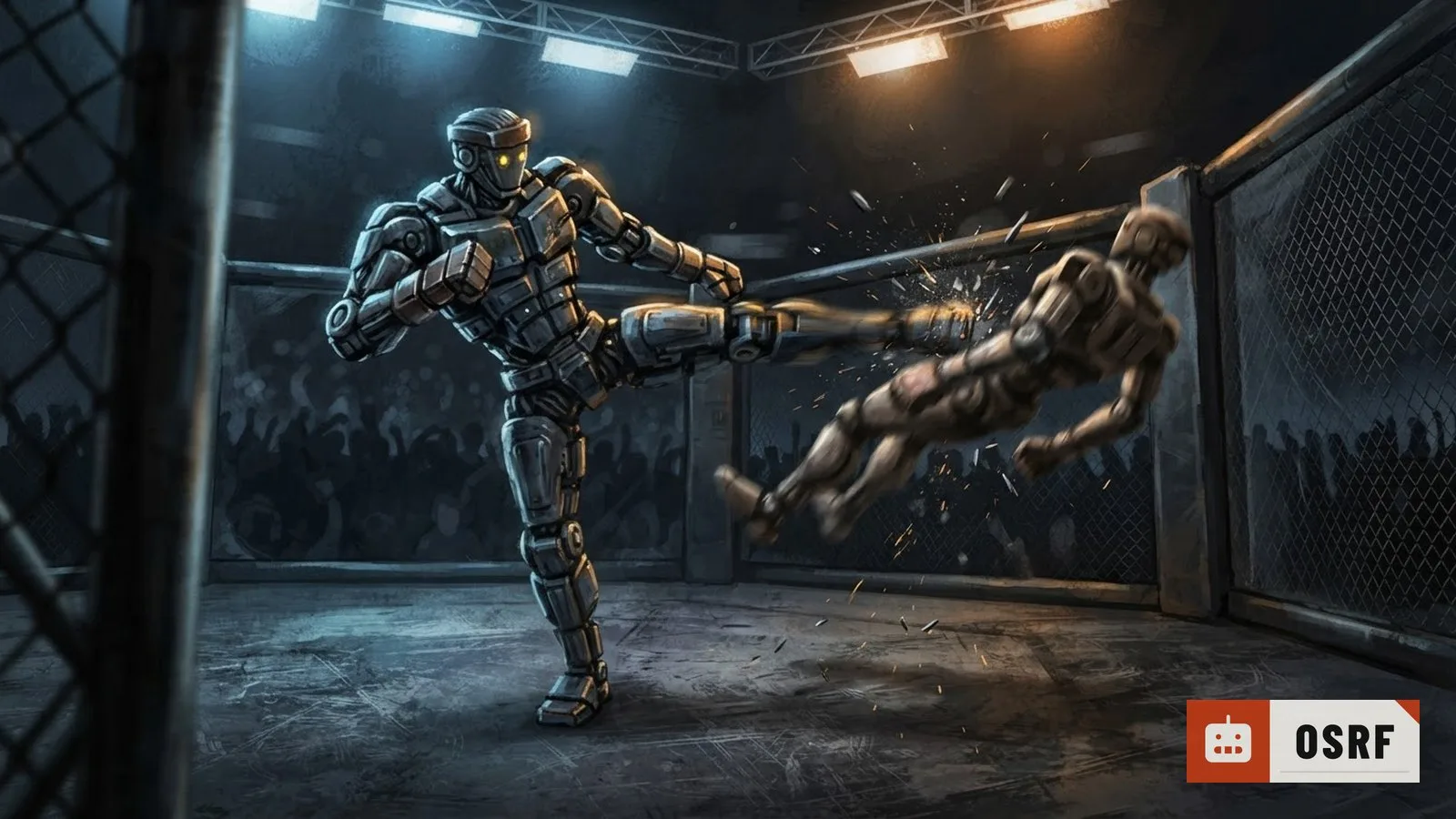
American influencer's cage fight with Chinese 'Terminator' robot draws millions and regulators
In San Francisco, content creator Frankie LaPenna stepped into an octagon to face multiple Chinese humanoid robots, including a modified T800 'Terminator' unit about 1.82 meters tall and weighing roughly 90 kilograms, whose head had been replaced with a skull-like shell. The show, staged by local company Robot Entertainment Kombat, or REK, went viral as LaPenna opened with full-power attacks that barely affected the machine, which answered with fluid combinations that eventually forced him to the ground. The robots were run on a hybrid control system that mixed VR or gamepad inputs from human pilots with AI-assisted balance and motion execution.
California regulators quickly clamped down. The Department of Consumer Affairs ruled that the bout violated boxing laws because it was an unapproved combat exhibition involving a human and sent a cease-and-desist order to REK CEO and Terminator robot owner Cix Liv, while the State Athletic Commission oversees such fights under state rules. REK disputes that existing regulations, written for human-versus-human contests, should apply when one competitor is a robot, and says its core business of robot-versus-robot fights is unaffected.
REK's concept grew out of earlier failed attempts to build a mixed-reality esports platform and later a VR fitness product. After seeing China use Vision Pro headsets to tele-operate humanoid robots, Liv turned to VR-driven robot combat, launching the REK0 tournament in September followed by the REK America tour in five U.S. cities that November. REK now sources off-the-shelf Chinese humanoids, focuses on control systems and showmanship, and has opened a San Francisco shop that serves as a robot repair garage by day and arena by night, offering sales, maintenance, rentals, training, testing and demos.
The format has proved a magnet for both would-be pilots and critics. REK's online simulator REK Sim logged 3,670 matches in its first tournament, with the top two virtual fighters flown to San Francisco for a live showdown, while nearly 500 people have reportedly emailed asking to fight robots in person. Skeptics dismiss the premise as humans really fighting other human operators, with some media dubbing it "human cockfighting in humanoid form." Even so, REK has used storylines like pitting a Twitch co-founder against a UFC fighter via robots and touting cross-gender and cross-age brackets to market the sport as a real-world version of films like "Real Steel."
Commercial robot shows go global as China's rental market cools and prices collapse
At the IFA 2026 tech fair in Berlin, Chinese firm Unitree Robotics transplanted a familiar sight from Chinese malls into a European exhibition hall: a boxing ring filled with humanoid robots in gloves, their movements remotely controlled by staff. The spectacle, long a staple of shopping-center entertainment in China, drew tightly packed crowds overseas, with visitors cheering and filming every performance.
Back home, however, the economics of such performances are shifting fast. Lei Technology reports that the once red-hot Chinese market for commercial robot shows has seen rental prices plunge by around 90 percent. Daily rates for humanoid performers that used to run 10,000 to 30,000 yuan have fallen to just a few thousand, while some listings on resale platforms advertise "traffic-attracting" deals as low as 200 to 300 yuan per day. That means a 20,000-yuan budget that might previously have covered a single robot dancing Yangko at a storefront for a day or two can now pay for multiple machines over several days.
Analysts at Lei Technology argue that the crash in rental fees signals the performance segment moving onto a more sustainable track, rather than collapsing. After Unitree's "YangBOT" routine on the 2025 Spring Festival Gala turned basic humanoids and quadruped "robot dogs" into national sensations, small rental operators could charge high fees and recoup their investments in weeks by touring malls and streets nationwide. As supply has caught up with demand, performance robots are becoming cheaper, more widespread tools for attracting foot traffic instead of rare novelties.
Unitree warns investors as humanoid valuations soar and industry risks mount
As commercial buzz intensifies, Chinese listed company Unitree Technology has cautioned investors that humanoid robots remain in the early stages of commercialization. In a stock-trading abnormal volatility announcement, Unitree said the sector still faces uncertainty in core technology maturity, downstream demand, and supply-chain capacity, any of which could delay large-scale rollout and weigh on its future revenue and profit growth.
Unitree's share price surged more than 30 percent over three trading days from October 16 to October 20, 2026, triggering an abnormal-volatility alert under Shanghai's STAR Market rules. The company's rolling price-earnings ratio reached 388.25 as of October 20, compared with an industry average of 39.51 for general equipment manufacturing, according to China Securities Index Co. Unitree explicitly warned of "valuation reversion" risk and urged investors to make prudent, rational decisions.
Turkmenistan launches youth engineering contest with robotics and BattleBots
Ashgabat will host the "Young Engineer 2026" competition on April 25, bringing students and hobbyists together in four tracks ranging from smart manufacturing to robot combat. The event is organized by the Ashgabat City Committee of the Party of Industrialists and Entrepreneurs of Turkmenistan, the city's Education Department and the Magtymguly Youth Organization, according to the Education Ministry's website.
Students in grades 7 to 12 can present projects in "Smart Manufacturing and Service Technologies," while the "Robotics" track tasks individually competing students with building robots that collect balls and sort them into containers of different heights within 2.5 minutes. The top five in Robotics will qualify for the First Global Challenge 2026 world robotics championship. Younger pupils will enter a "Girls Code" Scratch contest, and a BattleBots category for robot fights is open to all ages. Pre-registration runs until April 15, with winners receiving valuable prizes from organizers and certificates of honor from the Education Ministry. The competition will take place at the Ojar Asia private enterprise building on G. Kuliyev Street 38 in Ashgabat.
ITV4 serves mid-week nostalgia, drama and robot showdowns
ITV4's Wednesday schedule mixes reality hunts, classic dramas and high-octane competition, according to TV Mix. Viewers can follow American Pickers as Mike and Frank scour a shed of movie memorabilia, watch Arthur Daley's latest scheme in Minder, and revisit an old-school kidnapping plot in an episode of The Sweeney. Classic detective fare continues with Sherlock Holmes investigating a marital murder case, while a witchcraft-themed story introduces a new ally in a fantasy series.
For adrenaline, Ice Road Truckers offers episodes centered on a drilling station transport and a missing derrick amid harsh conditions, and a period drama set in Bordeaux returns with a rebellion storyline. Films and sports round out the line-up, including the 2019 crime movie "The Gentlemen," wrestling broadcasts featuring top stars, and episode 34 of a robot combat series in which the final showdown in Las Vegas crowns a champion. TV Mix describes the night as a "smorgasbord" spanning nostalgia, adventure and high-energy action.
EU to spell out workers' rights when AI systems rate, reward and and fire staff
The European Commission is drafting new "Quality Jobs" rules to help workers challenge key decisions made by algorithms in the workplace. Executive Vice-President Roxana Mînzatu said she hopes the proposal will be adopted on December 3 and envisages a single legal text covering algorithmic management, subcontracting and health risks at work. The initiative aims to clarify how human oversight, transparency and anti-discrimination safeguards should function when AI systems handle tasks such as recruitment, dismissal, performance reviews, rewards and sanctions, as well as data collection and intensity of work.
Mînzatu told reporters after a meeting of employment and social policy ministers in Luxembourg that employees generally know how to appeal decisions by human managers, but algorithmic rulings can be opaque and difficult to contest. She stressed that no one wants to duplicate the EU's existing AI Act or GDPR data rules, and that the new proposal will focus on making protections workable in practice rather than creating an "encyclopedia" of rights.
Irish Social Protection Minister Dara Calleary said ministers discussed job security, fair conditions, skills and career progression, providing input into the forthcoming rules but not creating new rights at this stage. Mînzatu said the Commission is considering targeted measures in sectors such as construction, agriculture, transport and cleaning, where precarious jobs and labor shortages coincide. The package will also address gaps in occupational health and safety, from weather exposure to psychosocial stress, with an emphasis on assessing risks and planning responses instead of overhauling the existing framework.
From URKL to REK: robot combat chases status as a standalone sport
Humanoid robot combat is moving from science-fiction spectacle to live sport and engineering testbed. In July, Chinese company EngineAI launched the Ultimate Robot Knockout Legend, or URKL, in Shenzhen, fielding 1.73-meter-tall T800 robots controlled by software and custom movement algorithms from 32 competing teams. One highlight saw a robot's kick send its opponent's head flying, yet the damaged machine continued fighting, a scene that would have looked like CGI a decade ago.
URKL illustrates how robot fights have evolved from earlier remote-controlled events like Robot Wars and BattleBots into humanoid clashes that demand balance, multi-joint coordination, and recovery from falls. EngineAI supplies a standard T800 platform while teams optimize code, sensors and mechanics, treating the arena as both a grueling test environment and a crowd-pleasing show. The pressure of combat helps expose weaknesses that may not appear in scripted demos, giving developers data while also building a fanbase for "wired warriors" as a potential new combat sport.
Robot boom tests business models as unicorns collapse and revenues lag
Despite surging shipments, the humanoid robot industry is undergoing a harsh shakeout. Data reported by Hong Kong 01 show that global humanoid robot shipments reached nearly 25,000 units in the first half of 2026, up 432.1 percent year on year, with market size rising 322.7 percent to 740 million U.S. dollars. At the same time, highly valued firms have run out of cash. Chinese company CloudMinds, once valued at 22.3 billion yuan, entered bankruptcy liquidation over debts of about 30 million yuan, while Silicon Valley's K-Scale Labs closed after burning through 6.25 million dollars and failing to secure a new 10 to 15 million dollar funding round. Geely-backed startup OneStar folded its team in under six months.
Industry breakdowns reveal that most robots are not yet doing heavy industrial work. A report from the China Academy of Information and Communications Technology said entertainment, commercial performances, science education and data collection together made up over 60 percent of global humanoid shipments in the first half of 2026, with guide and retail uses at about 19 percent, intelligent manufacturing around 13 percent and warehouse logistics only 5 percent. Research firm Frost & Sullivan estimated that just 700 humanoids worldwide were sold for production tasks in 2025 and 1,200 in the first half of 2026, representing under 6 percent of total shipments and modest revenues of 47 million and 78 million dollars respectively.
The economics of key components complicate hopes that volume alone will drive down costs. Industry estimates cited in the report put dexterous hand costs at having fallen from the 100,000-yuan level to under 10,000 yuan, but only by sacrificing configuration and degrees of freedom. Because such hands pack motors, reducers, tactile sensors and intricate wiring into a tiny space, their assembly labor and calibration keep costs from dropping along the same curve as batteries or solar panels. That makes "sell at a loss, win on volume later" strategies risky, particularly as some firms chase industrial deployments that require robust, high-spec hardware.
Financial results illustrate divergent paths. Unitree recorded revenue of 1.699 billion yuan in 2025, with 591 million yuan in net profit attributable to shareholders after non-recurring items and a gross margin of 60.13 percent. It shipped more than 5,500 humanoid robots, the most worldwide, and earned 867 million yuan from humanoids, surpassing its four-legged robots for the first time, though quadrupeds still contributed over 40 percent of revenue. UBTech reported 2.001 billion yuan in 2025 revenue and 820 million yuan from full-size humanoids, up more than 22-fold on the year and totaling 1,079 units sold with a 54.6 percent gross margin, but still booked a net loss of 703 million yuan and negative operating cash flow as it invested heavily in industrial use-cases. Shanghai-based Zhiyuan posted 1.05 billion yuan revenue for 2025 and an estimated 50-billion-yuan valuation, roughly a 48-times price-to-sales ratio, with income closely tied to ecosystem partners and raising questions about sustainability.
IDC has raised its 2030 global humanoid shipment forecast to over 750,000 units, about 50 percent above its previous estimate, citing China's rapid advances in motors, reducers and joint modules. But Hong Kong 01 notes that more than 20 robot firms worldwide faced bankruptcy, layoffs or divestitures in 2025 alone. The outlet concludes that companies likely to survive will need profitable mass production, cash flow that does not depend on the next funding round and at least one scenario where customers keep coming back; outfits that lack two of the three may simply be waiting for money that never arrives, no matter how compelling their stories sound.
Chicago delivery robots hit with biometric privacy lawsuits
In Chicago, two customers have filed class-action lawsuits accusing delivery robot operators Coco Robotics and Serve Robotics of collecting biometric data without consent. The suits, lodged in Cook County court on October 9, allege that the companies' robots scanned faces and hands as people retrieved deliveries, in violation of Illinois' Biometric Information Privacy Act. The law requires written notice, written consent and clear retention and destruction policies when biometric identifiers are collected.
Plaintiff Mitchell Breidinger says a September 2025 DoorDash grocery order was assigned to a Coco robot without him choosing that option. His complaint says he had to stand close to the machine to enter a code, during which its cameras recorded his face, head and hands, while LiDAR sensors measured their geometry and a remote operator watched live video. Another plaintiff, Barry Schain, alleges that he received three Uber Eats deliveries from Serve robots, most recently on October 4, also without opting in to robot service. Both men claim video and sensor data are stored alongside names and addresses and used to train AI systems; Schain's lawsuit cites Serve disclosures about licensing datasets to third parties, while Breidinger's filing claims Coco shared data with OpenAI and others.
Spokespersons for both companies deny collecting biometric data from customers or passersby. Serve said it "will defend against" the lawsuit, and Coco called the case "frivolous," insisting that its technology has not gathered biometric information in Chicago and that compliance with privacy laws is a "top priority."
AI startups face off in TechCrunch Disrupt 2026 Startup Fight final
TechCrunch Disrupt 2026's Startup Battlefield has produced a top five dominated by artificial intelligence ventures, according to reporting from Zhiding. The finalists span sectors from anti-fraud to security and industrial automation, with the eventual winner set to receive 1 million U.S. dollars in equity-free funding. Twenty startups made it to the main stage before judges narrowed the field to five for the final round.
The lineup includes Apate.ai, which fights phone, message, email and social-media scams by deploying its own AI bots to impersonate potential victims and waste fraudsters' time while collecting intelligence. Flox Intelligence offers a wildlife monitoring system that uses sensors on fences, cameras and other edge devices to detect and identify animal movements, issuing alerts to protect both animals and infrastructure. Intero Biosystems has developed lab-grown intestinal tissue models for drug testing, aiming to give researchers more realistic platforms for studying how treatments affect the gut. Industrial Next builds large language models to automate tasks at human workstations, using AI to perceive, plan and execute complex steps that previously required manual labor. Satlyt is creating a multimodal mapping service that uses satellite data and AI to help companies monitor and optimize asset performance worldwide, promising cost savings and better decision-making.
The final is scheduled to begin at 11:30 a.m. Pacific Time, with the five founders presenting their products on stage and via livestream before judges select a winner. Organizers say the competition highlights how deeply AI is now embedded across industries, from cybersecurity and biology to heavy industry and space-based mapping.
California cage fight controversy puts REK at center of MMA robot debate
Spanish daily Mundo Deportivo reports that REK's human-versus-robot cage fight has ignited debate over how combat sports should treat humanoid machines. The company marketed the Frankie LaPenna bout as the first fight in history between a human and a robot and promoted the powerful, remote-controlled humanoids as terrifyingly skilled opponents. The viral impact quickly drew the attention of the California State Athletic Commission, which issued a cease-and-desist order on grounds that any boxing or MMA event involving a person requires licensing and official oversight.
REK founder Cix Liv has pushed back, arguing that rules drafted for human-on-human contests should not apply when the other combatant is a robot. The dispute could become an early legal test case for a nascent industry that is only just beginning to blend humanoid robotics with live combat sports. While California has frozen human-robot fights for now, REK maintains that its robot-only events are safe, legal and continuing. The company says it has already staged 15 shows across nine cities in Japan and the United States, as questions grow over whether regulators should treat robotic spectacles like traditional combat sports.
'Boring' laundry robots and the quest for a scaling law in embodied AI
Dyna Robotics embraces being called "the most boring robot company in the world," a label the New York Post once used after seeing its machines quietly fold towels instead of performing viral stunts. Co-founder Jason Ma told 36Kr that the firm sees that as the highest compliment, because real-world deployment is the only meaningful performance metric. Its Dyna-1 and Dyna-2 "Taku" robots are designed to load washing machines, run cycles, unload clothes, dry them and then fold and shelve garments, focusing on reliability rather than spectacle.
Ma argues that practical robots do not fail for lack of legs or arms but because their models and systems are not robust enough for messy environments. To address that, Dyna has shifted from a vision-language-action, or VLA, architecture to what it calls a World Action Model, training on 1 million hours of first-person human video. The team reports that as training data scales, the model becomes better at predicting robot actions for scenarios it has never explicitly seen, hinting at a "scaling law" for embodied AI akin to those observed in large language models.
Speaking with 36Kr's Chen Xi and guest co-host and robotics engineer Zhang Junwu, Ma said Silicon Valley's robotics scene is in a burst of activity, with many companies choosing similar paths of expanding data and capabilities before aiming at general-purpose robots. He cautioned that at least one or two further breakthroughs are needed before the field reaches a "GPT moment," and suggested that summer timing may partly explain the cluster of product launches.
China's grip on rare earth magnets looms over humanoid robot boom
OilPrice.com reports that China's dominance in rare earth magnets is becoming a strategic choke point for the global humanoid robot industry. Every humanoid requires up to 4.5 kilograms of rare earth magnets to move, and China produces more than 90 percent of the world's supply. When Beijing began requiring export licenses for rare earth magnets in 2025, Tesla CEO Elon Musk told investors that production of the company's Optimus robot had been affected. The United States relies on imports for 100 percent of its heavy rare earth compounds and metals, including dysprosium and terbium, which are critical for magnets that can withstand high temperatures and are covered by China's export controls.
Research firm IDC counted nearly 25,000 humanoid robots shipped worldwide in the first half of 2026, more than five times the figure a year earlier, with most units coming from China. A senior Chinese industry official has said the country's humanoid robot output is on track to exceed 100,000 units in 2026. In July, Tesla shut down its Model S and Model X lines in Fremont to install Optimus production facilities and has outlined a long-term plan for capacity of 1 million robots per year, while China continues to ramp up faster.
Each humanoid typically uses around 30 motors, each requiring a magnet, tightening the link between robot production and rare earth supply. Canada- and U.S.-based company REalloys, listed on Nasdaq under the ticker ALOY, is trying to build a supply chain outside China, with plans for processing in Saskatchewan and metal production in Ohio. OilPrice.com notes that as Goldman Sachs lifts its forecast to about 6.5 million humanoids sold annually by 2035, roughly five times its previous estimate, any licensing decision in Beijing could stall entire production lines in other countries unless alternative magnet sources are developed.
Samsung tests 24/7 humanoid worker ahead of possible CES 2027 debut
Samsung Electronics is developing a bipedal humanoid robot for around-the-clock factory and logistics work and is considering showing it at CES 2027 in Las Vegas. Korea JoongAng Daily reports that Samsung's Robotics eXperience division is testing the machine at the company's R&D campus in Seoul, where it is learning to navigate industrial environments and perform repetitive tasks such as transporting goods. One industry source said employees from Samsung and partner firms are monitoring the robot in three shifts, underscoring its 24-hour design goal.
Shandong backs 'embodied intelligence + tourism' with mountain-climbing assist robots
China's Shandong provincial government has issued a "15th Five-Year Plan" for tourism that highlights embodied intelligence as a new growth area. IT Home reports that the blueprint calls for deepening "AI + tourism" applications, nurturing new productive forces and building an "AI + tourism" ecosystem tailored to local conditions. A key element is exploring real-world uses of embodied intelligence, including supporting mountain scenic areas in deploying climbing-assist robots.
The plan also envisions AI-driven travel tools and immersive cultural experiences. Shandong wants to build an "AI itinerary assistant" using cultural and tourism technology platforms to generate personalized trip recommendations, and to create mixed-reality guide systems offering real-time, interactive experiences that blend virtual and physical elements. Scenic sites will be encouraged to roll out digital human guides and apply AI-generated content and 3D printing to innovate cultural and creative product design and production.
Sources (16)
We summarise the news in our own words. Full credit to the outlets below for the original reporting, click through to read their work.